Master Diploma · N° 1
Classical & Contemporary French Vegan Pastry
Le programme complet, semaine par semaine. 8 semaines, du 15 mars au 7 mai 2027.
Texte en anglais, langue des cours ; traduction française à venir.
Master Diploma · N° 1
Le programme complet, semaine par semaine. 8 semaines, du 15 mars au 7 mai 2027.
Texte en anglais, langue des cours ; traduction française à venir.
This eight-week intensive is ideal for:
The program is particularly suited to students who want to create pastries that are not only “free from,” but truly excellent: elegant, structured, flavorful, beautiful and worthy of a professional pastry counter.
The program is structured progressively, moving from the foundations of pastry formulation to the most technical areas of French pastry.
Week 1 establishes the essential building blocks: creams, sauces, various ganaches, caramel, gelées and glazes. introduction to various tart doughs .
Week 2 focuses on applications of basics to create classical entremets and layered French desserts: sponge structures, mousses, inserts, creams, assembly and finishing. Fraisier, Opéra, Forêt Noire, Rolled cakes, Fruit Entremet
Week 3 gives students proficiency in the most familiar pastries of all French people : « travel cakes such as madeleines, financiers, cannelés, pound cake; various fine cookies often used as a part of plated desserts; the creamy desserts such as flan, clafoutis, far breton, tarte normande; as well as brioche and beignets - a sophisticated French doughnut
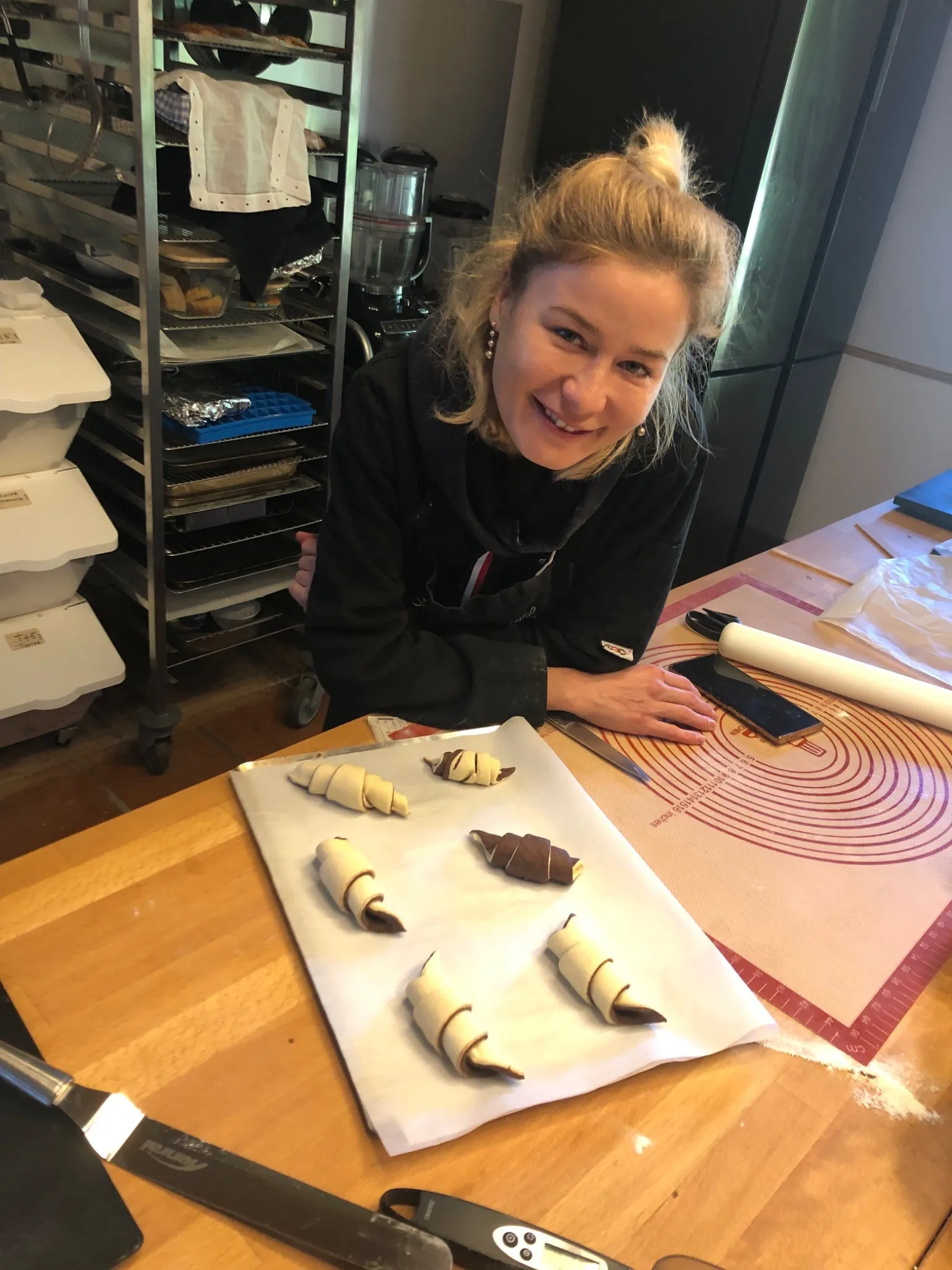
Week 4 is dedicated to one of the most challenging areas of vegan pastry: puff pastry, ( mille-feuilles and galettes des rois) and raised puff pastry, (croissants, bi-colored croisssant, pains au chocolat, pains aux raisins, Kuign aman and some modern variations)
Week Five is about pastries and desserts traditionally based on egg white which we will replace by aquafaba or potato protein: Meringue, Pavlova, Dacquoise, Lady’s fingers, Charlotte pastry and of course beautiful and imaginative macarons!
Week Six takes the student into the creation of sophisticated entremets, petit fours and advanced tarts. Students will be required, with assistance, to recreate some of the more contemporary versions of the classics!
Week Seven challenges students with the singularly most difficult pastry for vegan chefs - Choux Pastry. During this intensive week, we will make choux balls, profiterole, eclairs, Paris Brest pastries, the iconic Saint Honoré pastry and to finish a Choux tower
Week Eight is about chocolate ( buying it, tempering, use in desserts, bonbon making, nut pralines, fruit use in desserts such as apple tatins and a whole day on ice cream! Our last morning, we will visit a well-known chocolate factory and museum near the school.
By the end of the eight weeks, students will have developed a broad and coherent understanding of vegan French pastry, from everyday boutique pastries to more elaborate professional desserts.
Lodging included.
Classical and contemporary vegan French Pastry This eight-week professional intensive is dedicated to the art and science of vegan French pastry. It is designed for pastry chefs, vegan chefs, culinary professionals, entrepreneurs, teachers, and ambitious home bakers who want to master the foundations of French pâtisserie in a fully plant-based format.
French pastry is built on precision, texture, structure and balance. In this program, students learn how to recreate the great classics of French pastry without butter, milk, gelatin, cream or eggs — while preserving elegance, pleasure, technical discipline and professional presentation.
This is not a simple collection of adapted recipes. It is a complete technical training in vegan pastry: creams, sauces, tarts, entremets, laminated doughs, viennoiserie, petits fours, macarons and chocolate work.
Students will learn not only what to make, but why each recipe works: how to replace eggs intelligently, how to create stable creams and mousses, how to laminate doughs, how to balance starches and nut flours, how to manage moisture, how to obtain clean slices and professional finishes, and how to create desserts that are beautiful, delicious and commercially viable.
This program brings together two highly sought-after skills:
The discipline, precision and elegance of classical pâtisserie.
The ability to replace dairy, eggs, gelatin and traditional fats with plant-based alternatives while maintaining flavor, texture and structure.
Together, these skills form a rare and valuable expertise for today’s pastry professionals.
As more clients request desserts that are plant-based, professionals need serious training that goes far beyond substitution. This program teaches students to think like pastry formulators, not merely recipe followers.
The first week is dedicated to the core preparations that appear throughout French pastry. Students learn how to make stable, flavorful and elegant creams and fillings without eggs, milk, cream or butter, and how to create egg and butter-free tart doughs that are crisp, tender, workable and professional.
This week is fundamental. Many failures in vegan pastry come from weak foundations: creams that are too starchy, tart shells that crumble, fillings that are unstable, textures that are heavy, or flavors that lack refinement. Week 1 teaches students how to build balance from the beginning.
Students begin with the essential creams of French pastry in gluten-free vegan form:
The focus is on texture, stability, mouthfeel and flavor. Students learn how to replace eggs without creating heaviness, how to avoid excessive starchiness, how to obtain a smooth and glossy finish, and how to adapt each cream for different uses: tarts, entremets, choux-style fillings, layered desserts and plated components.
This day explores sugars and caramel; the sauces and accompaniments that bring freshness, contrast and elegance to pastry:
Students learn how to balance acidity, sweetness, thickness and shine. The day also introduces the role of sauces in professional presentation: not as afterthoughts, but as essential elements that complete a dessert.
Students learn how to create shine, clean slices, stable fillings and refined finishes. This day links the world of tarts to the world of entremets, preparing students for Week 2.
Students learn the principles of tart dough formulation:
The practical work includes fruit tarts, pastry cream tarts and citrus curd tarts. Students begin to understand how different fillings affect tart shell texture, moisture resistance and final presentation.
This day builds on the previous work by exploring richer and more complex tart compositions:
Students learn how to combine textures: crisp shell, creamy filling, fruit freshness, chocolate intensity, nut richness and decorative finish. The emphasis is on creating tarts that are both elegant and commercially attractive.
Week 2 is dedicated to the great French entremets and layered desserts. Students move from individual components to complete composed pastries, learning how to combine sponge cakes, creams, mousses, fruit inserts, glazes, ganaches, syrups, textures and finishes.
The goal is not simply to imitate classics, but to understand their architecture.
Génoise can be used in many ways depending on the thickness it is made into. It is a somewhat dry, fine-grained cake that holds up well when covered with creams and mousses that on a moister, larger-grained cake would make them disintegrate. We will make today three genoise: vanilla, chocolate and a marbled or striped one and will use one to make a personalized rolled cake - filled, glazed
Students begin by preparing all the ingredients for the Fraisier entremet which is a lovely creation of cake, strawberries, a diplomat cream, diced strawberries in a delicate syrup and a strawberry gelée .
These bases are then used to create a classic Fraisier entremet. Students learn how to build a dessert with clean layers, stable cream, fresh fruit, proper moisture control and an elegant finish.
Technical focus:
The Black Forest cake introduces chocolate sponge, cherries, cream, syrup and decoration. Students learn how to adapt a generous classic into a vegan version that remains light, moist and balanced. We will do two versions - one classical and one as contemporary as your imagination and technique can achieve.
Technical focus:
Opera cake is one of the most technical French entremets because it depends on precision, thin layers and balance. Students prepare the traditional-style Opera cakes in vegan form, working with sponge, coffee, chocolate, cream and glaze.
Technical focus:
The week concludes with the making of a very sophisticated and elaborate entremets, allowing students to apply the week’s techniques to one fruity masterpiece. Students work on precise desserts with multiple components: sponge or other bases, mousses and creams, inserts, glazes, decoration and final presentation.
Technical focus:
Expanding the Pastry Repertoire into the pastries of every day. Here are the little treats that France treats itself on a daily basis
Students begin the week with small French cakes and travel cakes that require careful texture control. They are called travel cakes as they can be eaten without a plate and a fork and also have no icing . This factor makes it very important that the moistness is sufficient for a good mouthfeel.
Preparations include:
Technical focus:
This day explores comforting and creamy French classical regional desserts, reimagined in vegan form.
Preparations include:
Technical focus:
Whether for tea-time or used to plate a dessert, fine cookies are an integral part of fine French pastry making.
Preparations include:
The week continues and accelerates with enriched yeast doughs that are not laminated but require structure, softness, fermentation and moisture control.
Students prepare:
Technical focus:
The last day of this week, treats students with some of France’s most comforting desserts that can also be served from breakfast throughout the day.
Preparations include:
Pain perdu ( this is the real French toast and we will practice using both the traditional baguette but also brioche as well plating with sauces and compotes to take it to a truly elegant level.)
Sauces and accompaniments will be produced also.
This week allows students to broaden their repertoire while refining precision, presentation and finishing. The recipes are diverse, but the technical themes remain connected: structure, moisture, sweetness, texture, stability and elegance.
Week 4 is devoted to one of the most demanding areas of vegan pastry: laminated and fermented doughs.
Traditional puff pastry and viennoiserie depend on gluten elasticity, butter plasticity, fermentation control and precise handling. Removing dairy butter and eggs makes this work significantly more complex. This week teaches students how to approach laminated doughs with a strong technical understanding of what must be replaced, strengthened and controlled.
Students learn the difference between classic puff pastry, raised puff pastry and how each behaves in a vegan context.
This week is a rare opportunity to study vegan lamination in depth.
Students begin with puff pastry through the iconic mille-feuille. The focus is on creating layers, crispness, lift and controlled baking.
Technical focus:
This day explores puff pastry in two different forms: the festive King’s Galette and savory or elegant vol-au-vent cases.
Students learn how laminated dough behaves in filled, sealed and shaped applications.
Technical focus:
Croissants are among the most challenging pastries to recreate without dairy or eggs. This day is dedicated to understanding laminated yeast dough: structure, elasticity, fat distribution, fermentation and baking.
Technical focus:
Students continue their work with raised laminated dough by preparing two essential viennoiseries: pains au chocolat and pains aux raisins.
Technical focus:
The world of raised puff pastry has developed in the last ten years into an increasingly sophisticated palette of pastries. Today will be dedicated to bi-color croissant and molded puff pastry pastries
How to make mille-feuilles, galettes, vol-au-vent, croissants, pains au chocolat, pains aux raisins, babas, beignets and brioches
By the end of the the first two two-week program, students will have studied and practiced:
This week allows students to broaden their repertoire while refining precision, presentation and finishing. The recipes are diverse, but the technical themes remain connected: structure, moisture, sweetness, texture, stability and elegance.
Students will gain much confidence by mastering the replacement for egg white in French pastry making: delicate meringue work, macarons , pavlova and more.
Meringue work is essential in vegan pastry because it teaches aeration, stability, drying, sugar balance and humidity control.
Students prepare:
Technical focus:
Student’s will prepare:
Students will prepare:
Macarons are one of the most sought-after and technically demanding pastries in vegan and gluten-free pastry. Students learn how to approach macarons with precision and patience.
Students will prepare:
Technical focus:
Today will see the finishing of the fillings, the preparation of the shell duos; the filling of the shells and any decor decided upon.
Student’s will prepare:
This class takes the student into the creation of sophisticated entremets, petit fours and advanced tarts. Students will be required, with assistance, to recreate some of the more contemporary versions of the classics! Students will be required to make a very sophisticated and contemporary version of 5-7 pastries done in the first few weeks by veganizing the creations of famous French pastry chefs. The choice of which pastries will be done by each student will be decided ahead of class and the recipes partially prepared in advance. This exercise requires the student to use the knowledge they have attained during the first five weeks about individual pastries and about vegan transformation and substitution. Each pastry will be done with accompanying decorations and sauces to perfect the plating of said pastry after completion.
This week of study challenges students with the singularly most difficult pastry for vegan chefs - Choux Pastry. The science behind making this type of dough will be thoroughly studied. During this intensive week, we will make choux balls, profiterole, eclairs, Paris Brest pastries, the iconic Saint Honoré pastry and to finish a Choux tower.
Students will prepare:
The final week completes the program with a rich and diverse variety of topics from chocolate work and a visit to a chocolate museum and workshop to fruits and nuts fillings and a day of exploring ice-cream cakes. Students are introduced to chocolate work, fillings, molding and finishing, while the museum visit offers historical, cultural and professional context and the ice-cream cakes give a sophisticated recipe for any festive event.
Day 2 Chocolate: an introduction to what chocolate is, how it can be used, tempering, dipping, moulding spheres ; chocolate dipped fruit ; molded and decorated chocolate bars; truffles and Rochers
Technical focus:
Many programs teach French pastry. Some teach the vegan pastry foundation. Some teach detailed knowledge of ingredients and the science , some teach the classics. Very few teach all three together in a coherent professional curriculum.
This program is built specifically around the challenge of creating French pastry that is both vegan, professional and visually enticing.
Students learn the logic behind the recipes: structure, moisture, aeration, emulsification, setting, lamination, fermentation and finishing.
This allows them to adapt, troubleshoot and create their own pastries after the program.
The goal is not to make desserts that simply “work” animal products. The goal is to create pastries that are refined, beautiful and pleasurable.
Taste, texture, aroma, appearance and mouthfeel remain central.
Restaurants, hotels, cafés, caterers and pastry shops increasingly need desserts that can serve clients with different dietary needs. A professional who can produce excellent vegan French pastry has a rare and useful skill.
This program comes from years of experience in vegan gastronomy, professional pastry teaching and the development of plant-based French pastry before it became fashionable.
The training is rooted in conviction, craft and real-world practice.
*!